

Hard Money Loans
A hard money loan is short-term financing secured by real estate, where the property carries the file rather than your credit or your income. There is no minimum credit score, and credit problems including foreclosure and bankruptcy do not automatically rule out a transaction. GreenBridge lends from $50,000 to $30,000,000 in 31 states.
No credit check for your quote.
Credit Score
No Minimum
Term
6 to 36 Months
Loan Amount
$50,000 to $30,000,000
Where We Lend
31 States
Leverage
Up to 70% LTV
Timing
5 to 10 business days
Business-purpose financing only. Residential properties must be non-owner-occupied. Terms, leverage, and closing timelines vary by property and transaction.
What is a hard money loan?
A hard money loan is short-term real estate financing underwritten on the asset rather than on the borrower's paperwork. Terms run 6 to 36 months, payments are interest only, and approval focuses on the equity in the property, the property type and how marketable the collateral is. That is a different starting point from a bank or a conventional lender, which looks at credit history, income and debt-to-income before it looks at the property at all. At GreenBridge, hard money and private money describe the same financing.
How does the funding process work?

1. Prequalify
Finding out whether your scenario works comes first and takes about three minutes. The questions are about the property, the amount you need and what you are trying to accomplish. Checking eligibility does not affect your credit score.

2. Approval
A quote arrives along with the loan application. Once the application is complete and signed, the loan portal opens for document upload so the file can be pre-underwritten. The scenario is confirmed workable, subject to value and clear title.

3. Appraisal and Title
Valuation and title work run in parallel. Depending on the property and the scenario, the valuation is a full appraisal, a broker price opinion or an internal review, and the result sets the maximum loan amount available. Title identifies liens, judgments and recording issues early, while there is still time to clear them.

4. Closing and funding
Closing is scheduled once the remaining conditions are cleared, at a time and place that works for you. Once all closing documents are signed, they undergo a brief review to ensure all signatures were made. Once confirmed, the title company or closing attorney will disburse funds. Your loan advisor is available during closing for anything that comes up.
Who funds a hard money loan?
Every scenario is reviewed by GreenBridge and evaluated against our lending guidelines. Where it fits, GreenBridge is the lender. Where it does not, we place it with one of the lending partners in the GreenBridge Lending Network, which is what allows us to work with property types and credit situations a single lender would turn down outright. The review is the same either way, and the structure follows the scenario rather than the scenario being forced into a structure.
Can you get a hard money loan with bad credit, a foreclosure or a bankruptcy?
Often, yes. There is no minimum credit score on this program, and credit affects the leverage and the pricing available rather than serving as a universal eligibility cutoff. Past mortgage lates are not an automatic disqualifier. A prior foreclosure does not rule out new financing, and a bankruptcy that is no longer active can be workable. An active bankruptcy is much more limited and is reviewed individually.
A property in active foreclosure is workable as well. Those transactions fall under our foreclosure bailout program, which runs from $250,000 to $10,000,000 and is built around the payoff figure and where the foreclosure stands. The sooner that conversation starts, the more options remain.
How is a hard money loan different from a bridge loan?
Both are short-term, interest-only financing secured by real estate, and the difference is the situation rather than the product. A bridge loan is built for a straightforward transaction where timing is the only problem, a note coming due or a purchase ahead of a sale, and it reaches up to 75% loan-to-value on residential collateral with rates starting at 8.675%. A hard money loan is built for the transactions conventional guidelines are not written for, meaning credit problems, a prior foreclosure or bankruptcy, or unique collateral, at up to 70% with rates starting at 9.75%.
If the transaction is straightforward, meaning a standard property and nothing complicated in the way, bridge loans is probably the better page for you. If there is a complication in the deal, meaning a foreclosure or a bankruptcy behind you, a run of mortgage lates, unique collateral such as land or a manufactured home, or a transaction that has already been declined somewhere else, this is the right page.
Who qualifies for a hard money loan?
Qualification starts with equity. A borrower with meaningful equity in a property that has real market demand may still be a strong candidate even with significant credit issues. There is no minimum credit score, although credit history can affect the leverage and the pricing available. Income documentation is almost never required, and in rare cases we verify liquidity depending on the property, whether it is occupied and how the payments will be covered during the term. The loan must be for a business or investment purpose, residential collateral must be non-owner-occupied, and a personal guarantee is required.
A credible exit strategy matters as much as the approval. Short-term financing is meant to be transitional, so a refinance, a sale or a stabilization plan should be identifiable before the loan closes rather than after.
What property types qualify for hard money financing?
Residential, commercial and specialty collateral all qualify.
Residential investment property is the most common, meaning single-family homes, condominiums, townhouses and two to four unit buildings. Residential collateral must be non-owner-occupied, and leverage reaches up to 70% loan-to-value.
Commercial property is eligible as well, including multifamily of five or more units, mixed-use, office, retail and strip retail, warehouse and light industrial, self-storage, commercial condominium, automotive and daycare. Leverage on commercial collateral reaches up to 65%.
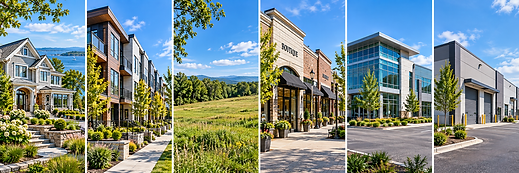
Specialty collateral is where this program separates itself from everything else on the market. Land, agricultural property, rural property and manufactured or mobile homes are difficult to finance through conventional programs and through most short-term programs, and all four are financed here. Each is reviewed individually, leverage on this collateral is lower than on standard residential, and the valuation required is determined by the property and the scenario.
Property location and marketability are part of the review on every scenario, since the value has to hold up in a sale. GreenBridge lends in 31 states.
Where the financing is long-term rather than transitional, two other programs may fit better. An investor who can qualify without verified income should look at stated income loans, and a business owner borrowing against real estate for the business itself should look at secured business loans.

How much can you borrow with a hard money loan?
Loan amounts run from $50,000 to $30,000,000. Maximum leverage is up to 70% loan-to-value on residential investment property and up to 65% on commercial property. Land, agricultural, rural and manufactured collateral funds at materially lower leverage, set by the valuation and the individual scenario rather than by a published cap.
Credit affects the leverage available rather than eligibility. A stronger profile can reach the maximum for the property type and a weaker one generally reduces the leverage and the pricing offered rather than closing the program off. Where a particular file lands depends on the whole picture rather than on the score by itself.
Where one property does not support the amount needed, additional eligible real estate can sometimes be pledged and leverage evaluated across the combined collateral. That is often the difference between a scenario that works and one that does not, and it is reviewed as part of your file rather than against a general list.
What loan terms are available on a hard money loan?
Terms run from 6 to 36 months, with 12 months the most common. Payments are interest only, which keeps the monthly obligation down while the property is being sold, stabilized or refinanced. The right term is the one that leaves enough room for the exit to actually happen, which is usually longer than borrowers estimate.
Prepayment terms vary by structure. Some transactions carry no prepayment penalty. Others require a minimum amount of interest or an interest reserve collected at closing, and where either applies it is set out in your mortgage commitment before you close rather than discovered later.
How fast can a hard money loan close?
A well-prepared transaction can close in 5 to 10 business days when the application and supporting documents are complete, title and any payoff figures are ready, and the required valuation can be scheduled promptly. Files that need a full appraisal, additional title work or further underwriting conditions take longer.
Specialty collateral is the usual exception. Land, agricultural and manufactured scenarios carry more involved valuation requirements, so those transactions sit at the longer end of the range rather than at the fast end.
What does a hard money loan cost?
Rates start at 9.75% and are quoted per transaction. Where a scenario prices depends on the property type, the location, the leverage requested and the overall risk of the transaction. Payments are interest only.
GreenBridge origination is based on loan amount, and additional lender and third-party fees may apply. Fees vary by transaction and are disclosed with your loan terms. Normal third-party closing costs also apply, including title, insurance and recording.
What actually controls the timeline?
Speed is the reason most borrowers are on this page, and two things decide whether a file actually moves at the fast end of the range.

Title. Title condition is the most common reason a timeline extends. Liens, judgments, open permits, probate issues and recording errors all surface in the title search, and each one takes time to clear regardless of how ready the rest of the file is. An existing title report, often from a refinance that did not close, may shorten the title process where it is current and acceptable to the closing agent.

Valuation. The valuation method is set during underwriting rather than by preference. Some files take a full appraisal, some use a broker price opinion, and others run on an internal review with photos and comparable sales. A file that needs a full appraisal moves on the appraiser's calendar, which is the one part of the timeline nobody in the transaction controls.
The third factor is the one you control. Documents returned the same day rather than the following week can materially change the closing timeline.
Common situations
Borrowers come to GreenBridge when the property or the file rules out a conventional answer, and the reason is different every time. The following are anonymized examples of transactions GreenBridge has worked on. Details have been changed to protect borrower privacy.
The lender backed out the day before closing
The situation
A first-time investor was buying a single-family rental outside Houston with 40% down. The day before closing, the lender he had been working with told him it could not do the loan. He had a signed contract, a seller expecting to close the next morning and no financing.
How we made it work
The transaction itself was strong. A large down payment, a property in a solid location and nearly every document we would need already in hand. Title work had been handled by the seller's side, as is typical on a purchase. We moved the file to the top of the queue that day and, because the timing was so tight, contacted the seller's agent ourselves, which we rarely do, to explain the situation and ask for a one-week extension. The seller agreed. This one qualified to close without an appraisal, which is not always the case, title needed only a one-day update, and the borrower returned every item the same day we asked for it. It closed in five business days.
A Virginia farm with foundation damage
The situation
A borrower owned a farm in Virginia with a main house on the land. He wanted to pull cash out to buy another parcel to use as pasture for his livestock, and he was worried his credit score and a recent bankruptcy would rule him out.
How we made it work
We reviewed the scenario as a whole rather than stopping at the credit report. The real obstacle came from the valuation, when the broker price opinion found damage to the foundation of the main house. Many lenders would have required that repair before funding. Given his timing, we kept the file moving and reduced the loan amount slightly to account for the repair instead. The loan funded, and he bought the pasture.
Three liens that were not disclosed
The situation
A borrower needed to close quickly and told us there were no other liens against the property, so the loan was structured on that basis. The valuation came back as expected. About ten business days in, the title report showed three liens that had never come up, two judgments and a tax lien.
How we made it work
Nothing closes until title is clear, and title cannot be cleared until every lien has a current payoff built into the loan. The tax lien and one of the judgments produced payoffs quickly. The other judgment creditor took twelve business days to respond. The loan closed in about 25 business days. Had the liens been disclosed at the start, those payoff requests would have gone out on the first day and the same loan could have closed in roughly 15. Title will find anything recorded against a property. Telling us early is what lets the slowest parts of the process start first.
Frequently Asked Questions
Can I get a hard money loan with bad credit?
Do you check credit?
Can I get financing after a foreclosure or a bankruptcy?
Do you lend on land or agricultural property?
Do you finance manufactured or mobile homes?
What is the maximum loan-to-value?
What are the minimum and maximum loan amounts?
How long is the term?
Is there a prepayment penalty?
Do I need an appraisal?
Do I need to document my income?
Can I use a hard money loan on a property that needs work?
Does the property have to be non-owner-occupied?
What states do you lend in?
How should I read the guidelines shown on this page?

About GreenBridge Loans
GreenBridge Loans has been financing business-purpose transactions since 2020, on investment and commercial real estate. Where a scenario fits our own guidelines, GreenBridge is the lender. Where it does not, we place it with one of the lending partners in the GreenBridge Lending Network, so a transaction that falls outside one set of guidelines may still have a path to funding.
Last materially updated on October 4, 2026.